
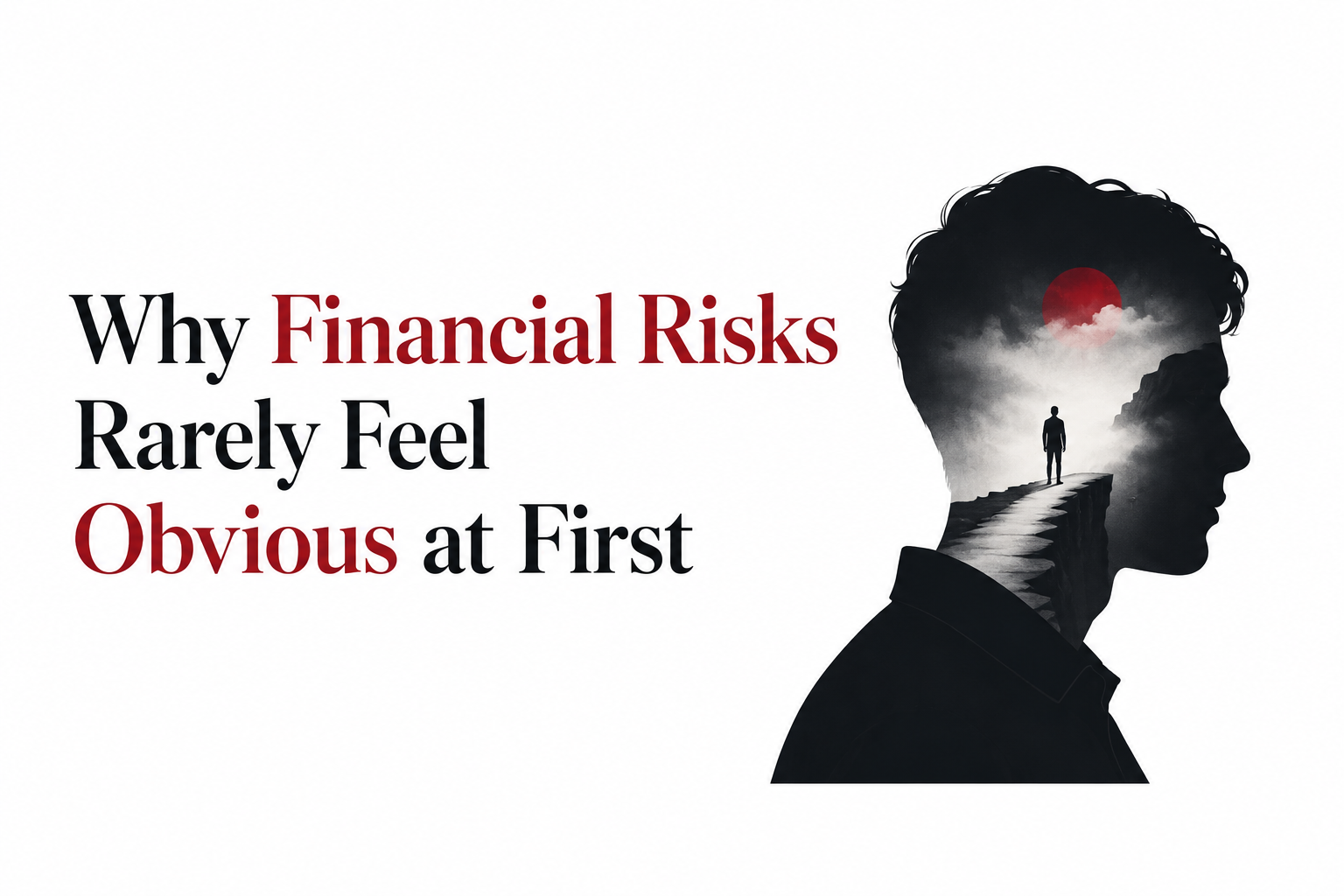
Most financial risk doesn’t arrive looking dangerous. That’s exactly why why financial risks rarely feel obvious at first becomes easier to understand only after something has already shifted. In the moment, things usually seem manageable, explainable, even reasonable.
It Usually Looks Like Opportunity First
Risk rarely introduces itself as a warning.
More often, it shows up dressed as growth, efficiency, timing, or a smart adjustment. A decision promises flexibility. A new direction seems practical. A small exposure feels acceptable because the upside looks immediate while the downside remains abstract.
That difference matters.
What is visible now almost always feels more convincing than what might happen later. If the gain is concrete and the loss is still hypothetical, the mind leans toward what it can already picture. Not because the person is careless, but because uncertainty has not become real yet.
At that stage, the decision doesn’t feel dangerous.
It feels open.
The First Stage of Risk Is Often Silence
One reason financial risk is hard to see early is simple: nothing bad happens right away.
There’s no immediate collapse. No sharp signal. In fact, the first phase often feels calm. Numbers hold. The system absorbs the pressure. Outcomes remain close enough to expectations that no one feels forced to stop and reassess.
That quiet period creates confidence.
A decision that survives its early stage starts to feel validated, even if the underlying exposure hasn’t changed. Time gets mistaken for proof. The absence of consequences becomes a kind of answer.
But silence is not safety.
Sometimes it is just delay.
Reasonable Choices Can Still Create Fragile Situations
This is the part people tend to miss.
Most risky financial decisions are not absurd when they are made. They come from logic that works inside the moment: cash flow needs to be protected, timing matters, pressure is rising, a market seems favorable, a cost can be postponed, a return seems strong enough to justify the move.
Each piece makes sense on its own.
That is exactly what makes the situation difficult. The path into risk is rarely dramatic. It is often built from rational decisions made under incomplete visibility. A series of acceptable steps can still lead into a structure that becomes unstable later.
Risk does not need bad reasoning to grow.
It only needs enough decisions that are locally justified and globally misaligned.
The Mind Reads Stability Too Quickly
There is a psychological shortcut built into financial decision-making. Once something appears stable, people begin treating it as safer than it is.
A few consistent outcomes, a period without disruption, familiar patterns, repeated success — all of this lowers internal resistance. What once required caution starts to feel normal. And once something feels normal, its risk level gets emotionally reduced long before it gets analytically reduced.
You can see this in small patterns:
- short periods of consistency begin to feel permanent
- repeated success starts to resemble proof of control
- manageable pressure gets reclassified as ordinary operating reality
None of these shifts happen loudly.
They happen through repetition.
Risk Hides Best Inside Partial Control
There is also a particular kind of danger in situations where people still feel somewhat in control.
If a person believes they can adjust, exit, correct, or respond later, the risk feels softer. Not absent — just delayed, and therefore less urgent. That belief often becomes the emotional bridge that allows a questionable decision to feel acceptable.
And sometimes it is true. Correction is possible.
But partial control is often overestimated in financial situations because outcomes don’t always wait for the moment when someone decides to intervene. Conditions shift. Liquidity tightens. Timing changes. A choice that seemed flexible suddenly becomes fixed by circumstance rather than intention.
That is usually when the risk becomes visible.
Not when it begins, but when room to correct it becomes smaller than expected.
The First Real Warning Often Feels Too Small
When financial risk finally starts to show itself, it often does so quietly.
Not through collapse, but through friction. A delay that should not matter, but somehow does. A number that misses by a little, then again. A correction that fixes part of the issue but leaves something unresolved. These signals are easy to minimize because they do not look like a crisis.
Yet that is often the real beginning of visibility.
Risk becomes noticeable not when everything breaks, but when the system stops responding with the smoothness people assumed it had. The structure begins to reveal how dependent it was on favorable timing, narrow margins, or conditions that no longer hold.
By then, the decision looks different than it did at the start.
It Rarely Felt Like Risk in Real Time
That is the hardest part to accept.
If you look backward, the risk may seem obvious. The exposure is visible, the assumptions are easier to question, the blind spots stand out. But hindsight creates a clarity that never existed in the same form during the original decision.
And that is why why financial risks rarely feel obvious at first is not really about people ignoring danger. It is about the way risk enters through reasonable logic, delayed consequences, and false signals of stability. It doesn’t need to disguise itself very much.
It only needs enough time before it becomes visible.