
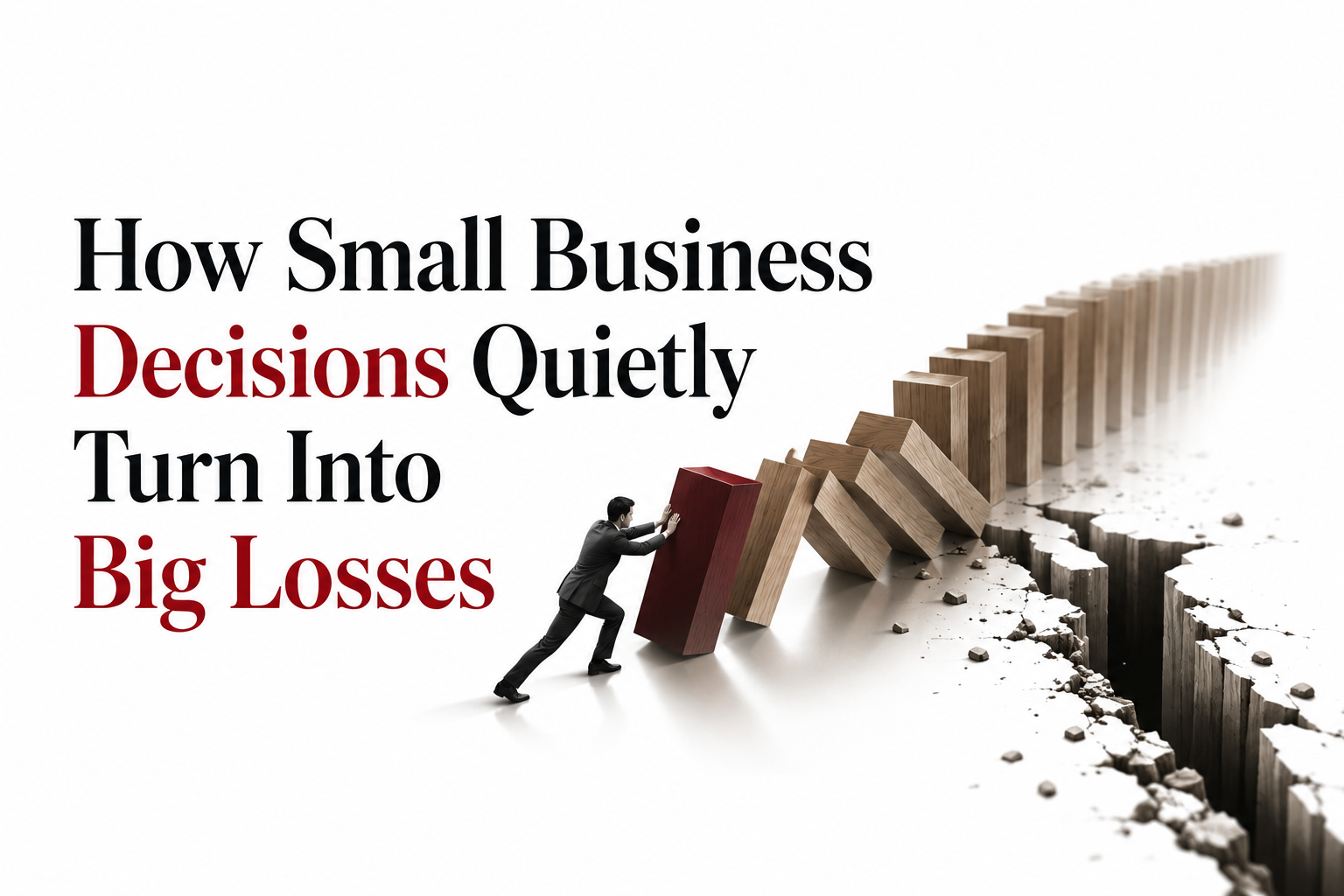
It rarely begins with anything dramatic. A minor adjustment, a quick decision, something that seems practical in the moment — and that’s usually how how small business decisions quietly turn into big losses starts to unfold, almost unnoticed at first.
The Decisions That Feel Too Minor to Track
Not every choice feels important enough to question.
You change a supplier because it’s easier. Delay a payment by a few days. Approve a slightly higher cost because arguing about it takes longer than accepting it. Each step is small, reasonable, and often justified by time or convenience.
Individually, none of these decisions look risky.
But what makes them different from larger, more visible choices is that they often go unexamined. They don’t trigger a second look. There’s no pause, no recalculation, no sense that something significant just happened.
And because of that, they accumulate quietly.
When Efficiency Starts Replacing Accuracy
At some point, speed becomes more valuable than precision.
You begin choosing options that move things forward quickly, even if they aren’t fully thought through. Not because you don’t care — but because there are too many moving parts to stop at each one.
This is where a subtle shift happens.
Processes that were once clear become slightly blurred. Margins get approximated instead of calculated. Assumptions replace verification. It all still works, just with less clarity than before.
Over time, a few patterns tend to emerge:
- decisions made without full context
- numbers accepted without double-checking
- outcomes judged by speed rather than accuracy
None of this feels like a problem immediately. It feels like progress.
The Moment It Stops Being Visible
Losses don’t always appear where they begin.
A small pricing adjustment might not show up until months later. A cost increase gets absorbed gradually. A delayed reaction to a change in demand only becomes obvious after it’s too late to adjust easily.
That delay makes everything harder to trace.
You’re not connecting cause and effect in real time. Instead, you’re reacting to outcomes that seem disconnected from the original decision. And because the link isn’t obvious, the same patterns can repeat.
It doesn’t feel like one mistake. It feels like a series of unrelated issues.
When “Temporary” Becomes Permanent
There’s also a category of decisions that were never meant to last.
A workaround put in place “just for now.” A compromise accepted for a short period. A simplified solution intended to be revisited later. These are often practical at the moment they’re made.
But revisiting them rarely happens on schedule.
Other priorities take over. The temporary solution becomes part of the system. And over time, it stops being questioned altogether.
You start building around it.
That’s where the impact grows. Not because the original decision was large, but because it stayed in place longer than expected.
The Cost of Not Noticing
The most difficult part is that nothing feels wrong right away.
Operations continue. Revenue still comes in. The business moves forward. But underneath that movement, small inefficiencies, overlooked costs, and accumulated compromises begin to shape the outcome.
It’s not a sudden drop. It’s a gradual drift.
And by the time it becomes visible, the source is already spread across dozens of decisions that made sense at the time.
That’s why how small business decisions quietly turn into big losses isn’t about obvious mistakes or poor judgment.
It’s about the quiet accumulation of choices that don’t seem important enough to question — until they are no longer small.