
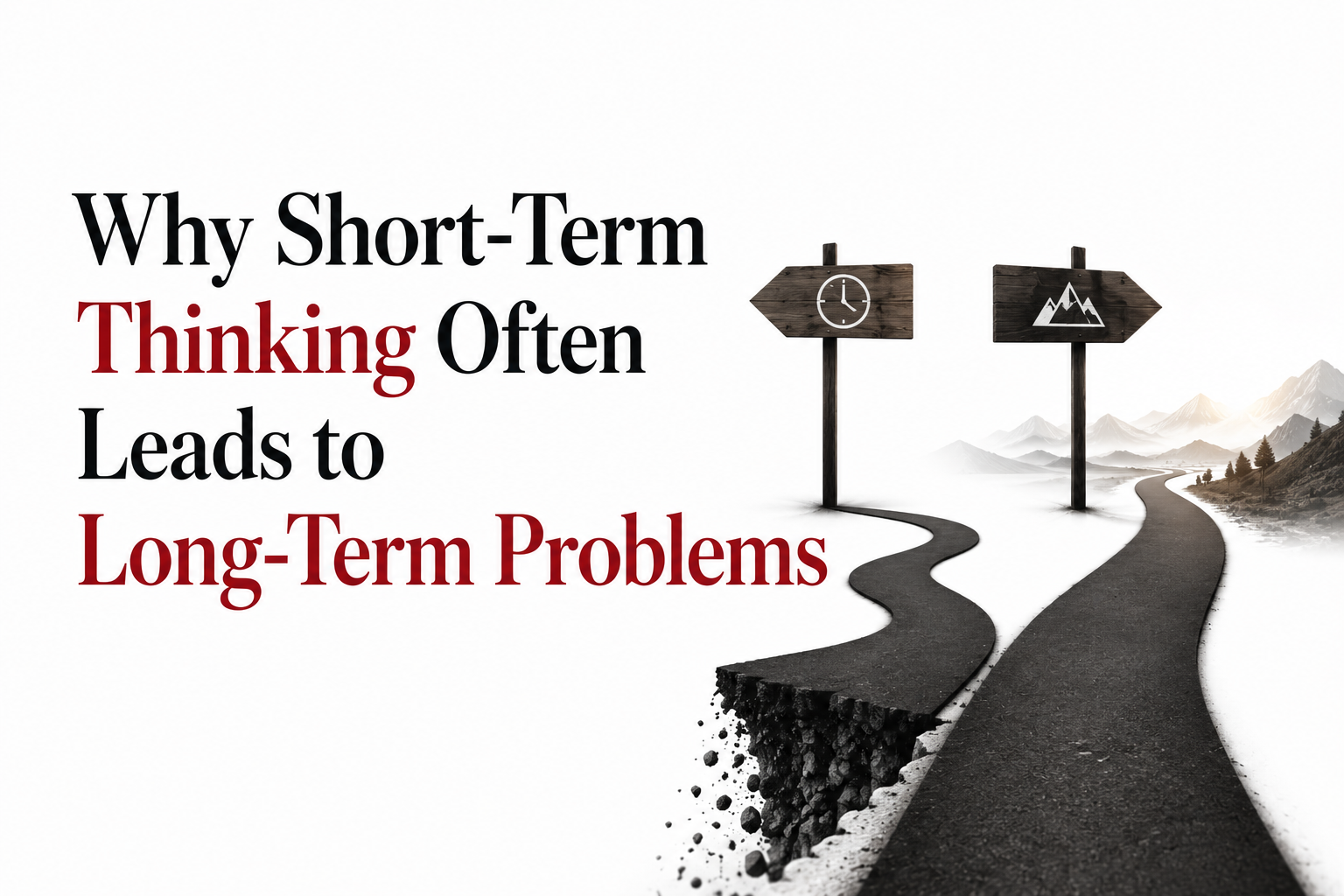
It rarely feels like a mistake in the moment. Decisions that solve something quickly often look reasonable, even necessary — and that’s exactly where why short-term thinking often leads to long-term problems starts to become visible, though not immediately.
The Comfort of Immediate Relief
There’s something very convincing about solving a problem fast.
A deadline is close, pressure is building, something isn’t working — and then there’s a fix. Not perfect, maybe a bit rough, but it removes the tension right away. That relief is real. You feel it almost instantly.
And once that pressure disappears, it becomes harder to question the decision itself.
You don’t always ask what this choice creates next. You just notice that the current problem is gone. That’s usually enough to move on.
When Small Shortcuts Begin to Stack
One shortcut doesn’t change much.
But they rarely stay isolated.
A quick adjustment here, a temporary workaround there — each one makes sense on its own. Together, they start to shape how things actually function. Not in a dramatic way, more like a gradual shift that’s easy to miss.
At some point, you begin to notice patterns:
- solutions that require repeated fixing
- processes that feel slightly more complicated each time
- decisions that depend on previous compromises
None of this feels urgent at first. It just becomes normal.
And that’s where things quietly change direction.
The Gap Between Now and Later
It’s not that long-term consequences are ignored.
They’re just harder to feel.
The present is specific. You can see the problem, measure it, react to it. The future is more abstract. It exists as a possibility, not as something you need to solve right now.
So the balance shifts without you noticing.
You start optimizing for what is visible and immediate, because that’s where feedback exists. The long-term effects don’t push back in the same way. They stay distant, almost theoretical.
Until they aren’t.
When Speed Starts to Define Decisions
There’s a point where speed becomes part of the decision itself.
Not just how fast something is done, but how quickly it can be resolved. That begins to influence choices more than expected. Options that take longer, even if they are more stable, start to feel less attractive.
Not because they’re worse — just because they don’t fit the pace.
This is where short-term thinking becomes structural.
It’s no longer about a single decision. It becomes a pattern that shapes how problems are approached in general.
It Doesn’t Break All at Once
What makes this difficult to notice is the absence of a clear moment.
There’s no single point where things “go wrong.” Instead, you get a slow accumulation. A system that still works, but requires more attention. A process that still functions, but feels heavier than before.
The change is gradual enough to adapt to.
Until the cost of maintaining it becomes higher than expected.
The Trade-Off That Isn’t Obvious
At the core, it’s always a trade.
Time now versus time later. Simplicity now versus complexity later. Certainty now versus flexibility later. These trade-offs aren’t hidden — they just don’t feel equal in the moment.
Because the “now” is always louder.
And that’s why why short-term thinking often leads to long-term problems isn’t really about bad decisions. It’s about decisions that make sense locally but shift the structure over time.
You don’t notice it when you make the choice.
You notice it when you try to move forward — and realize you’re already working around something that used to be simpler.