
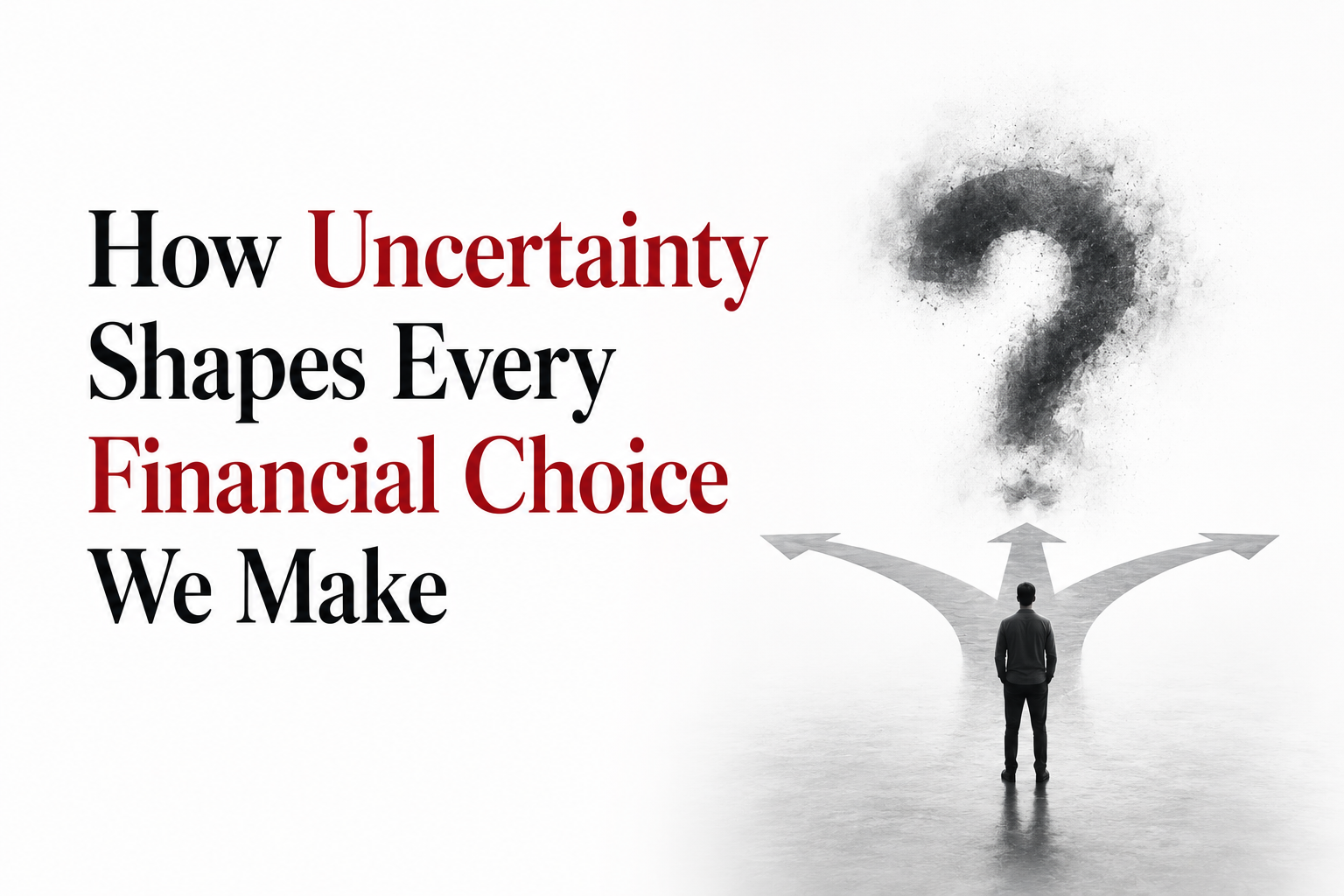
You don’t always see it clearly, but it’s there in almost every choice. The moment you try to decide what to do next, how uncertainty shapes every financial choice we make starts to show — not as something obvious, but as a quiet pressure behind the reasoning.
It’s Not About What You Know — It’s About What You Don’t
Most decisions feel grounded.
You look at numbers, past results, current conditions. There’s enough information to move forward, enough structure to justify a choice. It doesn’t feel like guessing.
But underneath that, there’s always something missing.
Not in a dramatic way. Just enough uncertainty to make the outcome slightly unclear. You don’t know exactly how things will unfold, only how they should unfold if everything behaves as expected.
And that “if” is doing more work than it seems.
The Difference Between Clear and Comfortable
There’s a moment where clarity and comfort start to blur.
A decision can feel right not because it’s fully understood, but because it aligns with what you want to believe. The more uncertain the situation, the easier it becomes to lean toward explanations that feel stable.
You don’t ignore uncertainty.
You organize it.
You frame it in a way that allows you to move forward. You focus on the parts that make sense and quietly set aside the parts that don’t yet have answers.
It’s not irrational. It’s necessary.
But it also means that the decision isn’t based on complete clarity. It’s based on a version of it.
When Waiting Feels Like a Risk
There’s an interesting shift that happens over time.
Uncertainty doesn’t always push people to pause. Sometimes it does the opposite. The longer something remains unclear, the more uncomfortable it becomes to wait.
At that point, action starts to feel safer than hesitation.
You might notice this in small ways:
- choosing to move forward without full confirmation
- treating incomplete information as “good enough”
- preferring momentum over perfect timing
None of these decisions are reckless on their own.
They’re responses to uncertainty that feels harder to sit with than to act through.
The Illusion of Control
Another layer sits just below the surface.
Even when outcomes are uncertain, there’s often a sense that the process itself is controlled. You can adjust, react, correct if needed. That creates confidence — not in the outcome, but in the ability to manage it.
And that confidence matters.
It makes uncertainty feel smaller than it is. It shifts attention away from what can’t be predicted and toward what can be handled later.
But control over the process is not the same as control over the result.
And that distinction only becomes clear afterward.
Every Choice Carries a Gap
If you step back, there’s always a gap.
Between what is known and what will actually happen. Between the reasoning behind a decision and the way it plays out. That gap doesn’t disappear with experience or better information.
It just becomes easier to work with.
You learn to operate inside it. To make decisions that acknowledge it without being stopped by it. To accept that outcomes won’t fully match expectations, even when the logic holds.
And that’s where the real shift happens.
It’s Built Into the Process
At some point, uncertainty stops feeling like an obstacle.
It becomes part of the structure — something every decision is built around, not something that can be removed. You don’t eliminate it. You move with it.
And that’s why how uncertainty shapes every financial choice we make isn’t about avoiding mistakes or finding perfect clarity.
It’s about recognizing that every decision already contains something unresolved — and learning how to act anyway, without pretending that it isn’t there.