
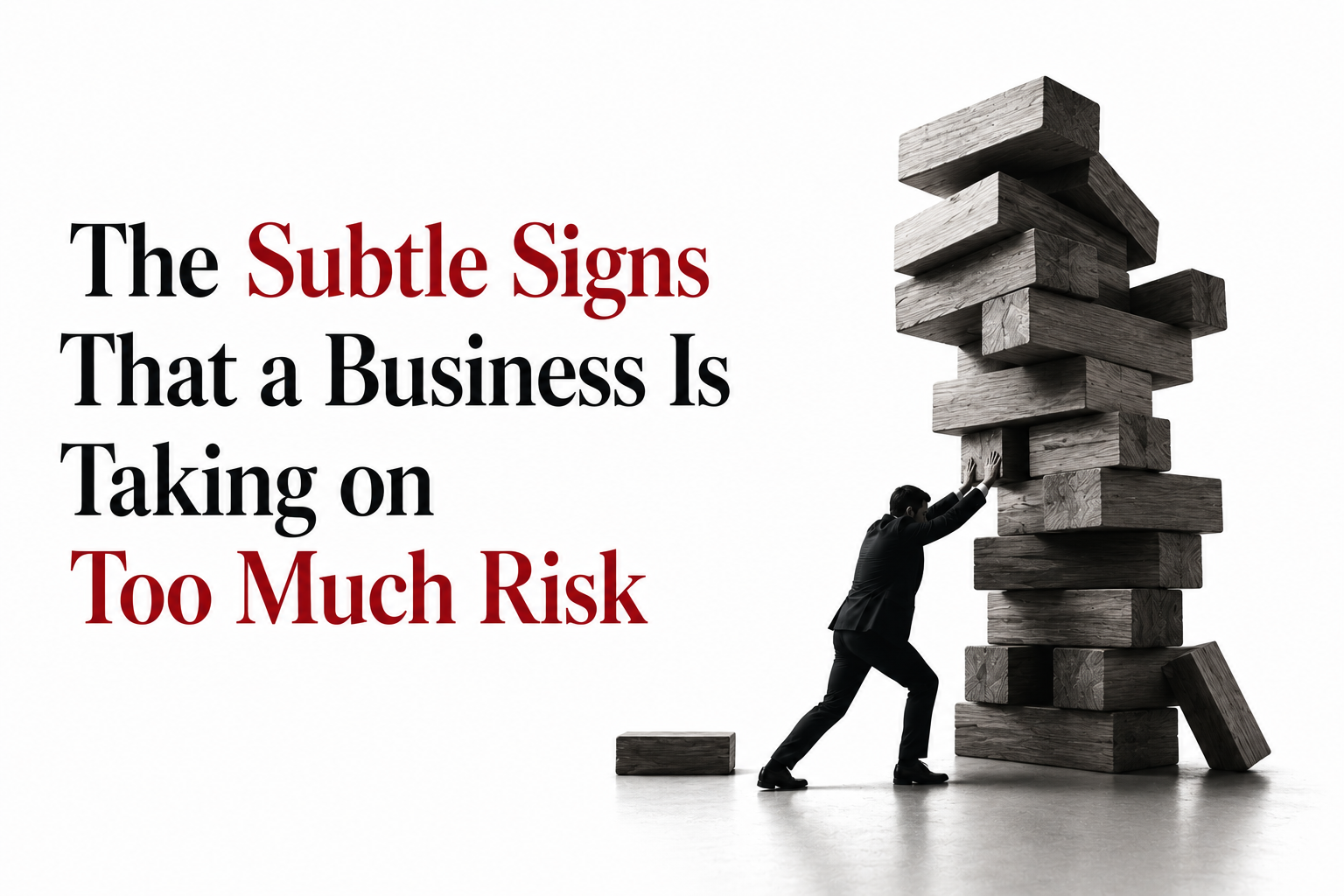
It rarely announces itself directly. More often, the subtle signs that a business is taking on too much risk show up in small shifts — things that don’t seem urgent on their own but start to change how decisions feel.
It Stops Feeling Like Risk
At some point, what used to feel like a stretch begins to feel routine.
Decisions that once required hesitation become easier. Not because they’re safer, but because they’ve been repeated enough to feel familiar. That familiarity creates a kind of comfort — the sense that “we’ve handled this before.”
But repetition doesn’t reduce risk. It only reduces how noticeable it is.
You start accepting conditions that would have seemed uncertain earlier. You move faster through decisions that used to require more checking. The threshold quietly shifts.
And that shift is hard to detect from the inside.
When Adjustments Replace Structure
There’s a difference between managing something and constantly adjusting to it.
In a balanced system, most things work without intervention. You step in when needed, but you’re not constantly correcting. When risk increases, that balance changes.
You begin to notice that:
- small fixes happen more often than expected
- outcomes need tweaking after the fact
- clarity comes after decisions, not before them
None of this feels critical. It just becomes part of the process.
But when adjustment replaces structure, it usually means the system is carrying more than it was designed for.
The Feeling That Things Are “Almost Under Control”
This one is easy to miss.
Everything seems close to working perfectly. Not quite there, but manageable. You feel like one more step, one more correction, one more cycle will bring things into alignment.
That sense of “almost” keeps things moving.
It prevents pause. It delays deeper changes. Because if everything is nearly under control, then stopping to rethink feels unnecessary.
But “almost stable” can stretch for a long time.
And during that time, the underlying pressure doesn’t disappear. It accumulates.
When Speed Becomes the Default
Another shift happens in how quickly decisions are made.
Faster isn’t always a problem. But when speed becomes necessary just to keep up, it changes the quality of attention. There’s less time to fully process each step, less space to see connections between them.
You might notice:
- decisions being made with partial visibility
- reliance on momentum instead of verification
- less distinction between urgent and important
Again, nothing dramatic.
Just a gradual move toward reacting instead of evaluating.
The System Feels Busy, Not Clear
One of the most telling signs isn’t a number or a specific outcome.
It’s a feeling.
The system stays active. Things are happening, being solved, being pushed forward. But the clarity that used to come with that activity starts to fade. You know things are moving, but it’s harder to see exactly how everything connects.
That doesn’t mean things are out of control.
It means they’re harder to fully understand in real time.
And that’s often where risk hides — not in obvious problems, but in reduced visibility.
It Builds Before It Breaks
By the time risk becomes visible, it has usually been present for a while.
Not as a clear issue, but as a series of small shifts — in speed, in perception, in how decisions feel. Each one easy to explain. Together, harder to ignore.
And that’s why the subtle signs that a business is taking on too much risk don’t look like warnings at first.
They look like progress. Like adaptation. Like staying flexible.
Until the system starts asking for something different.
Not more movement.
More control than it currently has.