
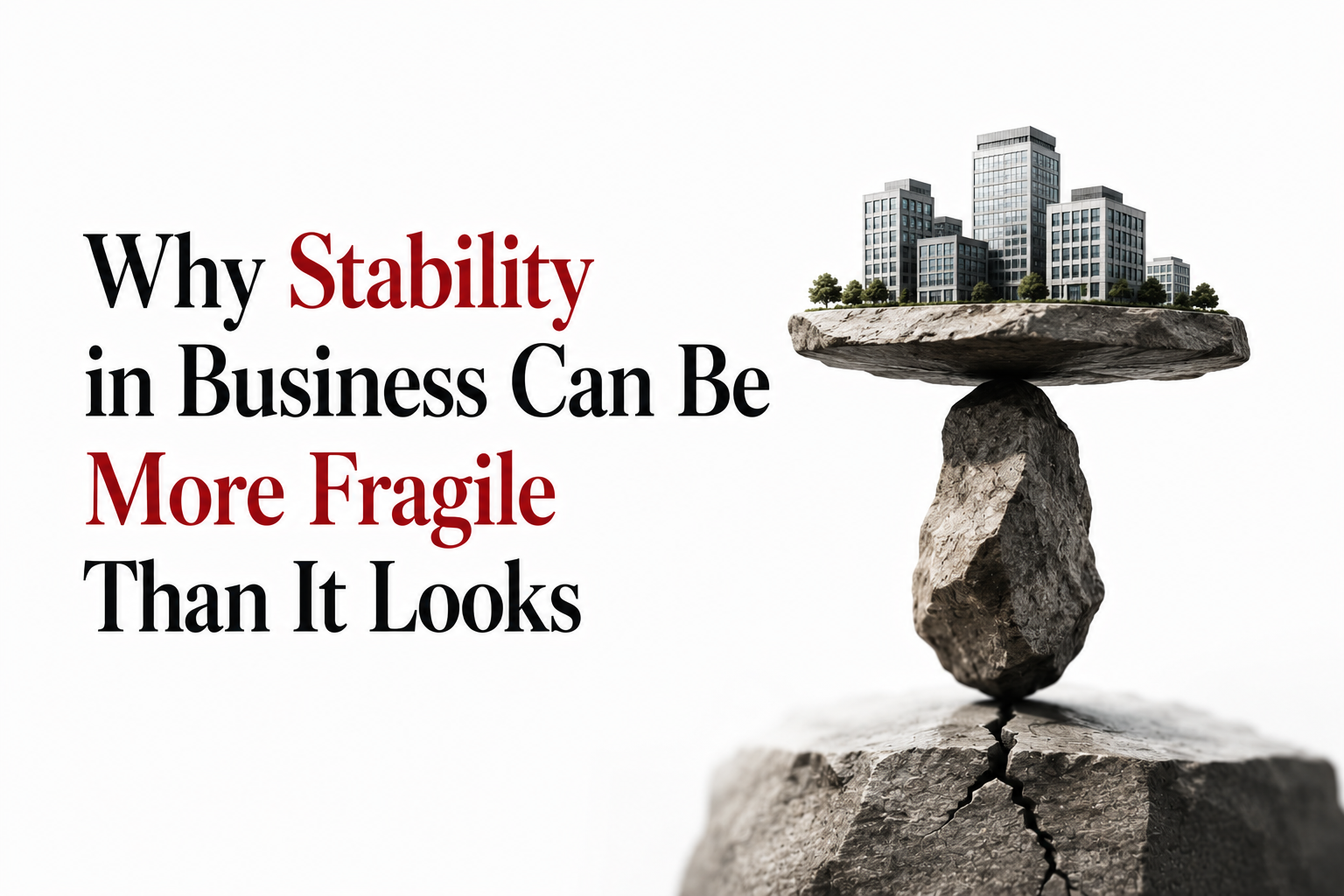
It can look solid from the outside — steady numbers, predictable activity, no obvious disruptions. But why stability in business can be more fragile than it looks usually becomes clear only when something small shifts and the whole structure reacts more than expected.
It Feels Stable Because Nothing Is Moving Too Fast
At first, stability often just means things aren’t changing much.
Processes repeat. Results fall into familiar ranges. There’s a rhythm to how decisions are made and how outcomes follow. That rhythm creates a sense of control — not perfect, but reliable enough.
And over time, that reliability becomes an assumption.
You stop checking certain things as closely. You trust that patterns will continue. Small irregularities get explained away because they don’t seem to break the overall picture.
But stability built on repetition is not the same as stability built on strength.
One depends on things staying the same. The other holds even when they don’t.
The Illusion of Balance
There’s often a moment where everything appears aligned.
Revenue matches expectations. Costs are manageable. Operations don’t require constant attention. It feels like the system has found its balance point.
But that balance is usually more sensitive than it appears.
A slight increase in pressure — a delay, a change in demand, a shift in timing — can move things out of alignment faster than expected. Not because the system is weak in an obvious way, but because it was calibrated for a narrow range of conditions.
It works well… until it doesn’t.
And when it shifts, the response is rarely immediate.
Small Dependencies You Don’t Notice
What makes stability fragile isn’t always visible.
It’s often hidden in the connections between things. One process depends on another, which depends on something else being consistent. As long as those links hold, everything feels smooth.
But they’re not always obvious.
You might not realize how much depends on a specific timing, a certain volume, or a particular sequence of actions. And when one of those shifts, the effect travels quietly at first.
Then it becomes noticeable.
Sometimes in ways that don’t seem directly related to the original change.
When Stability Turns Into Inertia
There’s another side to it that’s less obvious.
Stability can make adjustment harder.
When things are working, even if only within a narrow margin, there’s less urgency to rethink structures. Processes stay as they are because they haven’t caused problems yet. Decisions are made based on what has worked before.
Over time, that creates a kind of inertia.
Not resistance to change, exactly — more like a preference for not disturbing what seems to function. But that preference can delay necessary adjustments until they become more difficult to implement.
By then, the environment may have already shifted.
The Moment It Becomes Visible
Fragility doesn’t always reveal itself dramatically.
Often it shows up as a mismatch. Something that used to align no longer does. Results that were predictable become uneven. Small corrections don’t fully fix the issue.
And the realization comes in parts.
Not “everything is unstable,” but “this part isn’t behaving the way it used to.” Then another part. Then the connections between them.
At that point, stability is no longer assumed. It has to be rebuilt, not just maintained.
It Was Never Static to Begin With
What makes this tricky is that stability is rarely a fixed state.
It’s something that exists only as long as conditions support it. Change those conditions — even slightly — and the system has to adapt. If it can’t adjust quickly enough, the stability that once felt solid starts to feel uncertain.
And that’s where why stability in business can be more fragile than it looks becomes less of an idea and more of an experience.
Not because things suddenly break.
But because they were always more sensitive than they seemed.