
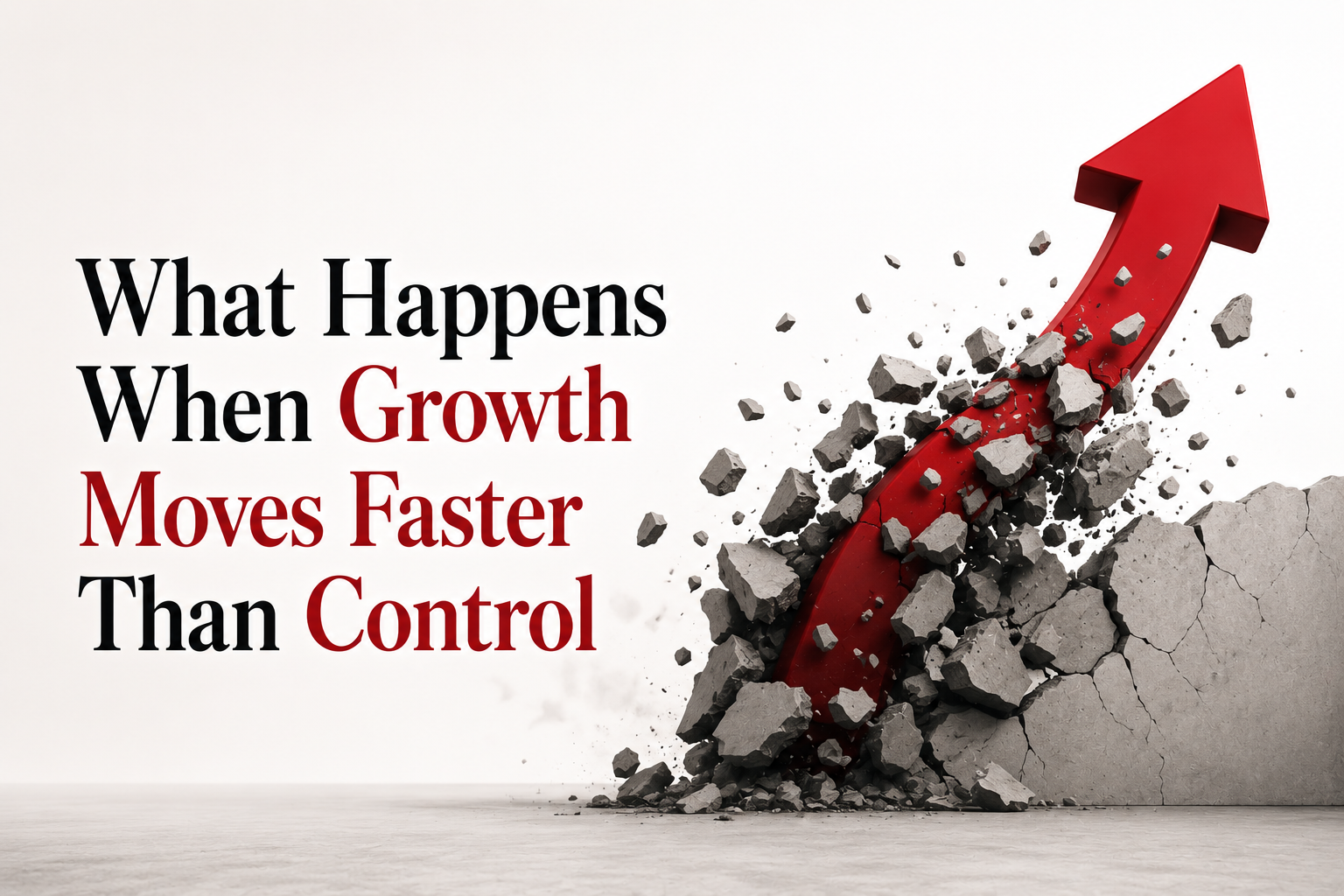
At first, it feels like momentum. Things are expanding, decisions are happening quicker, numbers are going in the right direction. Only later does it become clear what what happens when growth moves faster than control actually looks like from the inside.
It Feels Like Progress — Until It Doesn’t
Growth rarely announces itself as a problem.
In the beginning, it looks like everything is working. More clients, more activity, more movement. The system stretches a little, but it holds. That creates a kind of confidence — the sense that things will keep adjusting as needed.
So you allow it.
You accept a bit more complexity. You postpone small fixes. You rely on the idea that structure can catch up later, once things slow down.
But they don’t slow down.
And the gap between what’s happening and what’s being managed starts to widen. Not sharply. Quietly.
The Invisible Delay Between Action and Control
There’s always a delay, but it’s easy to miss.
Every new process, every added layer, every increase in volume requires a response — some kind of structure to keep it stable. When growth is steady, that response happens naturally.
When growth accelerates, the response falls behind.
You keep making decisions at a faster pace than you can fully track. Not because you ignore control, but because control takes time. And time becomes the one thing that feels limited.
At some point, you’re no longer managing everything directly. You’re managing the idea that it’s still manageable.
When Small Gaps Start Connecting
Individually, nothing seems critical.
A missed detail here. A delayed adjustment there. Something that isn’t fully tracked, but still “understood.” Each issue feels temporary, explainable, not urgent enough to stop momentum.
But they don’t stay separate.
They begin to connect. One weak point affects another. What looked like minor inconsistencies turns into something harder to trace — a system where outcomes don’t always match expectations.
You might notice patterns like:
- things taking longer than they should, without a clear reason
- decisions needing rework more often than before
- results becoming less predictable, even with similar inputs
At that stage, the issue isn’t one mistake. It’s the accumulation.
The Shift From Control to Reaction
There’s a moment — not always obvious — when the dynamic changes.
Instead of guiding the process, you start reacting to it. Fixing what appears. Adjusting after something has already shifted. Trying to restore clarity instead of maintaining it.
It doesn’t feel like losing control.
It feels like staying busy.
And that’s what makes it difficult to recognize. Activity replaces visibility. As long as things are moving, it seems like they’re being handled.
But movement and control are not the same thing.
Why It’s Hard to Slow Down
By the time the imbalance is visible, slowing down feels risky.
There’s momentum to maintain. Expectations already set. External pressure, internal pressure — both pushing forward. Pausing to reorganize starts to feel like stepping back.
So instead, you try to stabilize while continuing to grow.
Sometimes that works. Often, it stretches the system even further.
Because control doesn’t rebuild itself in motion. It requires space. And that space is exactly what fast growth removes.
It Was Never About Growth Alone
Looking back, it’s rarely the growth itself that creates the problem.
It’s the mismatch between expansion and structure — between how fast things move and how quickly they can be understood, tracked, adjusted.
And that’s why what happens when growth moves faster than control doesn’t feel dramatic in real time. It develops gradually, inside decisions that seem reasonable, inside progress that feels deserved.
Until the system starts asking for something it hasn’t had enough of.
Not more movement.
More clarity.