
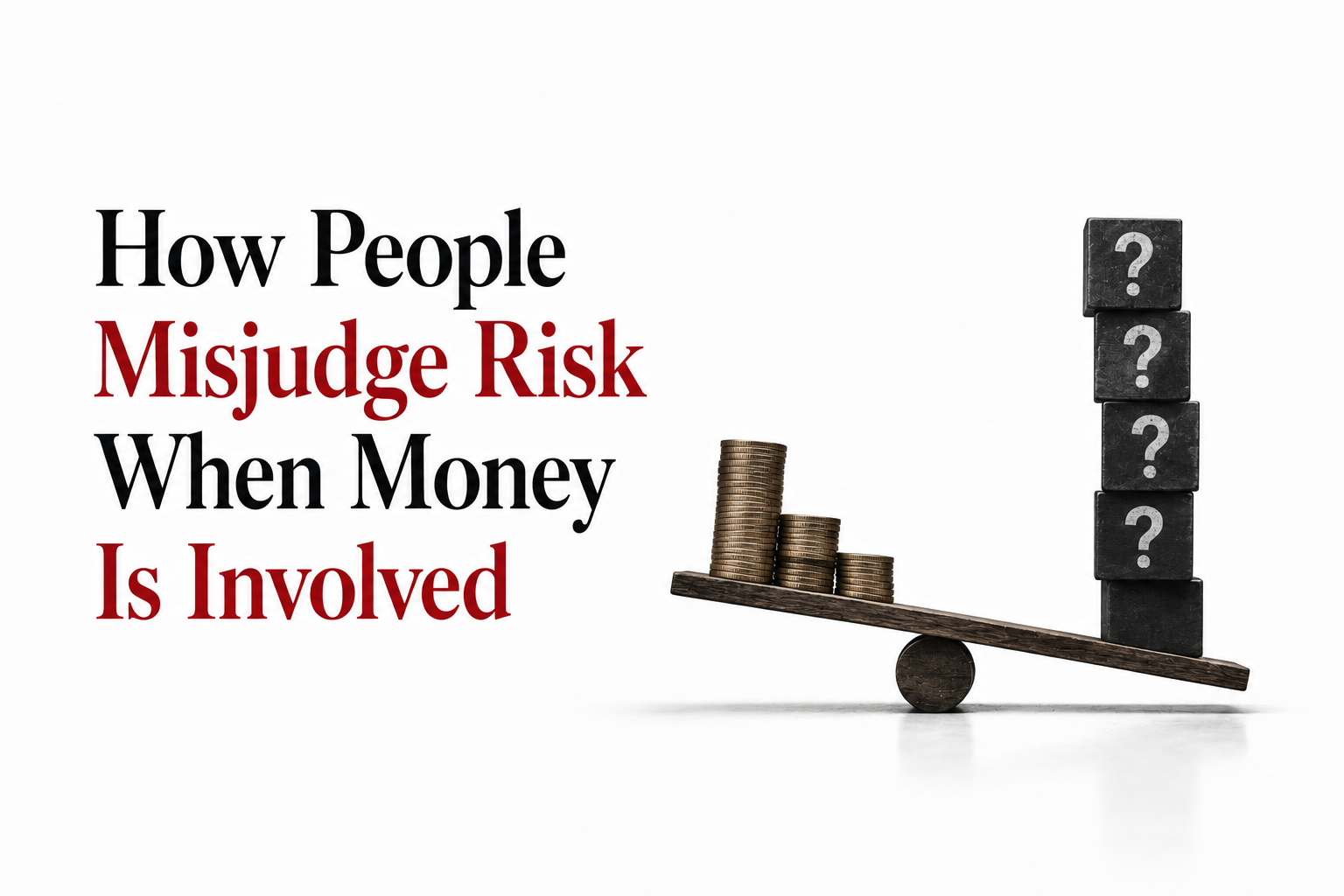
It doesn’t stay abstract for long. The moment real stakes appear, how people misjudge risk when money is involved becomes less about numbers and more about perception — what feels safe, what feels urgent, what feels worth it.
It Stops Being About Logic
At a distance, risk looks clean.
You compare probabilities, outcomes, scenarios. There’s a sense that decisions can be weighed objectively, like options on a table. But once money is involved — your own, or something you’re responsible for — that clarity starts to shift.
Not disappear. Just blur slightly.
Suddenly, the same situation feels different depending on what’s at stake. A small potential loss might feel larger than it should. A possible gain might seem more certain than it actually is.
The math hasn’t changed.
The feeling has.
The Way We Frame the Situation
What matters more than the risk itself is how it’s described — often internally.
You don’t usually think in raw probabilities. You think in narratives. “This will likely work.” “This is a temporary risk.” “This is the right moment.” Each version changes how the situation feels.
And those frames aren’t neutral.
They highlight certain parts and downplay others. You might focus on the upside and treat the downside as unlikely. Or do the opposite — fixate on what could go wrong and miss what’s actually manageable.
A few subtle shifts in thinking can completely reshape the same decision:
- calling something an “opportunity” instead of a “risk”
- treating a loss as temporary instead of structural
- assuming control where there is only partial influence
None of these are false on their own. But they tilt perception.
Experience Doesn’t Always Protect Against It
You might expect that experience makes this easier.
Sometimes it does. But not always in the way people assume.
Familiarity can reduce caution just as easily as it can improve judgment. If something has worked before, it starts to feel predictable — even if the conditions aren’t exactly the same.
That’s where misjudgment often slips in.
Not from lack of knowledge, but from overconfidence in patterns that only partially apply. You recognize the shape of the situation, and that recognition replaces a deeper check.
It feels efficient.
It isn’t always accurate.
When Risk Becomes Personal
There’s also a point where the decision stops being external.
It becomes tied to identity, responsibility, expectation. That changes how risk is processed. It’s no longer just about outcomes — it’s about what those outcomes mean.
You might notice it in small ways:
- hesitation when the downside feels like a personal failure
- pushing forward because stepping back feels like losing position
- holding onto a decision longer than necessary because it already “belongs” to you
At that point, risk isn’t evaluated cleanly. It’s filtered through something more subjective.
And that filter is hard to see from the inside.
The Quiet Gap Between Perception and Reality
What makes this tricky is that misjudgment rarely feels like misjudgment.
In the moment, everything seems justified. The reasoning holds together. The decision fits the situation as you understand it. There’s no obvious signal that something is off.
That gap — between how risk feels and what it actually is — stays invisible until results start to appear.
And by then, the perspective has already changed.
It’s Not Just About Getting It Right
Over time, you start to notice patterns.
Not perfect corrections, not flawless decisions, but a growing awareness of how perception shifts under pressure, under expectation, under involvement. That awareness doesn’t remove risk, but it changes how you relate to it.
Because how people misjudge risk when money is involved isn’t really about mistakes in calculation. It’s about the way context quietly reshapes judgment — long before any outcome makes it obvious.